

PRESS RELEASE
February 14, 2008
CASTING ANNOUNCEMENT: Romeo & Juliet, On Motifs of Shakespeare
Contact William Murray, 212.254.1357.
CASTING ASSIGNMENTS ANNOUNCED FOR THE MARK MORRIS DANCE GROUP’S HISTORIC PRODUCTION OF THE ORIGINAL VERSION OF PROKOFIEV’S ROMEO AND JULIET
THE PRODUCTION IS BASED ON PROKOFIEV’S ORIGINAL MUSIC AND THE ORIGINAL STORY CONCEPT BY SOVIET DRAMATIST SERGEY RADLOV, WITH NEW CHOREOGRAPHY BY MARK MORRIS
PRODUCTION WEBSITE NOW ONLINE AT WWW.LOVELIVES.NET
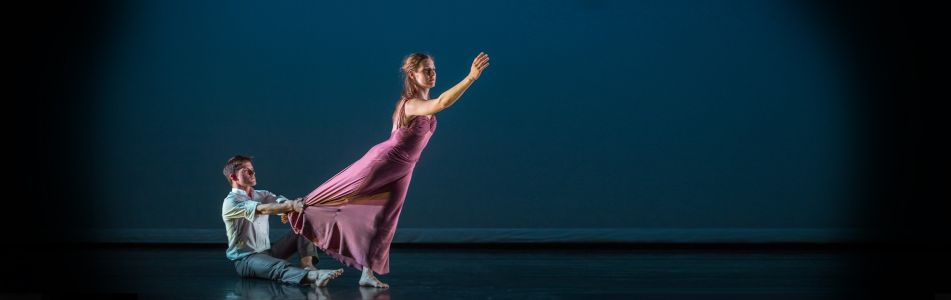
(New York, NY) – The Mark Morris Dance Group (MMDG) is pleased to announce casting for Mark Morris’ new production of Prokofiev’s Romeo & Juliet, On Motifs of Shakespeare, to premiere at the Bard SummerScape Festival July 4, 2008 at The Richard B. Fisher Center for the Performing Arts at Bard College.
The production will feature two alternating casts dancing the lead roles: MMDG dancers Maile Okamura and Noah Vinson; and Rita Donahue and David Leventhal. Additionally, the roles of the lovers' parents, the Montagues and Capulets, will be performed by former MMDG dancers Teri Weksler and Guillermo Resto, Megan Williams and Shawn Gannon respectively. A website dedicated to the production is now online at www.lovelives.net.
The premiere of Romeo & Juliet, On Motifs of Shakespeare, choreographed by Mark Morris, will be performed by the Mark Morris Dance Group and the American Symphony Orchestra (ASO), led by Leon Botstein. The production will feature scenic design by Allen Moyer, costume design by Martin Pakledinaz, and lighting design by James F. Ingalls, all of whom are longtime collaborators of Mark Morris.
This historic event features a new, fully-staged dance production by Morris set to Prokofiev’s original score and scenario by Soviet dramatist Sergey Radlov, based on exclusive documents unearthed in Moscow by Princeton University musicologist and Bard Scholar in Residence Simon Morrison and represents the first time Prokofiev’s music for Romeo and Juliet will be performed according to the composer’s instructions.
Commissioning the $1.1 million production in association with The Richard B. Fisher Center for the Performing Arts at Bard College and the Mark Morris Dance Group are: barbicanbite08, London; Cal Performances, Berkeley; Harris Theater for Music and Dance, Millennium Park, Chicago; Krannert Center for the Performing Arts, University of Illinois at Urbana-Champaign; Lincoln Center for the Performing Arts; Virginia Arts Festival; and additional, individual commissioners.
Dancers’ Biographies
Maile Okamura (Juliet) began working with MMDG in 1998 and became a company member in 2001. She was featured in Morris’ Resurrection (2002) and currently dances the role of Belinda in Dido and Aeneas. Originally from San Diego, California, Okamura was a member of Boston Ballet II in 1992-93 and Ballet Arizona in 1993-96. She has danced with choreographers Neta Pulvermacher, Zvi Gotheiner, and Gerald Casel, among others.
Noah Vinson (Romeo) began working with the Mark Morris Dance Group in 2002 and became a company member in 2004. He was recently featured as one of the soloists in ‘Double’ - part of Morris’ highly-acclaimed Mozart Dances (2006). Vinson received his B.A. in Dance from Columbia College Chicago, where he worked with Shirley Mordine, Jan Erkert, and Brian Jeffrey. In New York, he has also danced with Teri and Oliver Steele and the Kevin Wynn Collection.
Rita Donahue (Juliet) joined MMDG in 2003 and currently performs the role of Second Woman in Morris’ danced opera – Dido and Aeneas. Donahue was born and raised in Fairfax, Virginia, and attended George Mason University, where she graduated with honors in Dance and English in 2002. She has also danced with bopi's black sheep/dances by Kraig Patterson, a former MMDG dancer.
David Leventhal (Romeo) was raised in Newton, Massachusetts, and has danced with MMDG since 1997. He is best known for dancing the Nutcracker Prince in Morris’ The Hard Nut and the bird solo in Morris’ L’Allegro, il Penseroso ed il Moderato. Leventhal studied at Boston Ballet School and has danced with Jose Mateo's Ballet Theatre and the companies of Marcus Schulkind, Richard Colton/Amy Spencer, Zvi Gotheiner, Neta Pulvermacher, and Ben Munisteri. He graduated with honors in English Literature from Brown University in 1995. He teaches master classes in technique and repertory at schools and colleges around the country in addition to teaching regularly at MMDG's school in Brooklyn - including a class for people with Parkinson's disease. He is married to fellow dancer Lauren Grant.
Teri Weksler (Lady Montague), born in Baltimore, Maryland, and a graduate of The Juilliard School, was a founding member of the Mark Morris Dance Group. Performing with MMDG from 1980-1990, she originated one of the soloist roles in Gloria (1980), the Sailor in Dido and Aeneas (1989), and a duet opposite Morris, One Charming Night (1985). Weksler also assisted Morris on projects with Ballet West, Les Grandes Ballets Canadiens, and London Contemporary Dance Theater. She also danced with Daniel Lewis, Hannah Kahn, Jim Self, the White Oak Dance Project, and is a Bessie Award recipient. After moving to Birmingham, Alabama, she became director of Southern Danceworks, and currently teaches at the Alabama Ballet and Birmingham Southern College.
Guillermo Resto (Lord Montague) began dancing with Mark Morris in 1983. He is best known for originating the role of Aeneas opposite Morris in Dido and Aeneas (1989) and performing another duet with Morris, Love, You Have Won (1984). While on a 2002 MMDG Japan tour with world-renowned cellist, Yo-Yo Ma, Resto began making ink-on-paper prints of manhole covers. He continues his printmaking and exhibits in galleries and venues throughout New York City. Retiring from the Dance Group in 2003, Resto has returned to perform the role of Dr. Stahlbaum in Morris’ The Hard Nut each holiday season since 2005.
Megan Williams (Lady Capulet) born in Los Angeles, California, and a graduate of the Juilliard School, joined the Mark Morris Dance Group in 1988. She danced with MMDG for nine years, toured world wide and appeared in several films including Dido and Aeneas, Falling Down Stairs (with Yo Yo Ma), The Hard Nut, and The Hidden Soul of Harmony for the United Kingdom’s South Bank Show. Since 1999, Williams has been on the modern dance faculty of the Conservatory of Dance at Purchase College, SUNY. She has staged Morris’ works on the Purchase Dance Corps, George Mason University students, Vassar Repertory Dance Theater, the Boston Ballet, and is guest summer faculty at the Mark Morris Dance Center. Williams most recently performed One Captured Kiss at DTW (choreographed by Helen Pickett) in September 2007. In April 2008, she will be directing Paul Simon’s concert, Songs of the Capeman at BAM's Harvey Theater.
Shawn Gannon (Lord Capulet) received his early dance training with Dorothy Wescott Rosen and danced with MMDG from 1994 - 2004. Originally from Dover, New Jersey, he was a featured soloist in Resurrection (2002), part of the original cast for The Argument (1998), and danced the bird solo in L’Allegro, il Penseroso ed il Moderato. Along with Morris, Gannon has the distinct honor of being one of a handful of men to have performed Ted Shawn’s historical solo - Mevlevi Dervish. He has also performed with Lee Theodore’s Dance Machine, Mark Dendy Dance Group, Laura Dean Dancers and Musicians, and Jane Comfort and Company.
About Prokofiev’s music for Romeo and Juliet
According to Princeton musicologist Simon Morrison, Bard Scholar in Residence for the 2008 SummerScape and Bard Music Festivals, the project has no parallel in ballet history and will correct an historical injustice. It is perhaps hard to imagine that Romeo and Juliet, arguably the most popular ballet of the 20th century, has never been performed as the composer intended. But the original, intended Romeo and Juliet score, which is preserved at The Russian State Archive of Literature and Art, has never been performed, even though the composer left precise and detailed instructions with respect to the orchestration. It includes six new dance numbers, adding more than 20 minutes of new music and resulting in a radically different ending to the story.
Prokofiev conceived the ballet in 1935 in collaboration with innovative Soviet dramatist Sergey Radlov, who re-imagined the familiar tragedy “as a struggle for the right to love by young, strong, and progressive people battling against feudal traditions and feudal outlooks on marriage and family.” Much of Prokofiev’s score addresses the theme of love’s transcendence over oppression. However, in a radical gesture that caused a scandal in the Soviet ballet circles, Prokofiev and Radlov gave the ballet a happy ending. In the final scene, Juliet rouses from her potion-induced sleep just as Romeo begins to conclude that she has died. The two lovers express their feelings of relief and joy in a final dance. The music represents the two lovers willing away their world — the Verona square and palace — and entering another, greater one.
But this final act has never been staged. Prokofiev presented his score to Soviet cultural officials, who responded by canceling the premiere productions in Leningrad and Moscow. Prokofiev at first defended his and Radlov’s ending, arguing that “living people can dance, the dying cannot” and that “Shakespeare was himself said to be uncertain about the endings of his plays.” However, had he not rewritten the score, he would never have seen it staged.
The artistic climate in Stalin’s Russia darkened: in dance, music, and drama, conservative neoclassicism supplanted accessible innovation. Not only was Prokofiev forced to rewrite the ending of the ballet – replacing the entire fourth act with an epilogue, he was forced to insert large-scale solo dances for the Ball and Balcony Scenes, the result being a break-up of the dramatic flow. A divertissement involving three exotic dances in Act III was scrapped for logistical reasons. The Kirov Theater dancers complained about the difficulty of the rhythms and the original choreographer, Leonid Lavrovsky, insisted on thickening the orchestration. As the demands piled up, Prokofiev became increasingly frustrated, but each time, he acquiesced in an effort to see the work performed. The ballet received its Russian premiere in 1940. When Prokofiev saw it, he had a hard time recognizing parts of his own music. He pleaded to no avail to undo the changes that he had not sanctioned.
Sergey Prokofiev's Romeo & Juliet, On Motifs of Shakespeare, Op.64, restored by Simon Morrison, is performed with exclusive permission of the Prokofiev Estate and G. Schirmer Inc., the bearers of the rights to the music. Source materials used in this production are provided by the Russian State Archive of Literature and Art.
The presenters express their sincere gratitude to the Prokofiev Estate, especially Serge Prokofieff Jr., and to the director and assistant director of the Russian State Archive of Literature (RGALI), Tatiana Goryaeva, and Galina Zlobina, for making this event possible.
Special thanks to G. Schirmer, Associated Music Publishers, Inc. for their support of these performances.
A Fisher Center for the Performing Arts at Bard College/Mark Morris Dance Group production in association with barbicanbite08, London; Cal Performances, Berkeley; Harris Theater for Music and Dance, Millennium Park, Chicago; Krannert Center for the Performing Arts, University of Illinois at Urbana-Champaign; Lincoln Center for the Performing Arts; and Virginia Arts Festival.
